
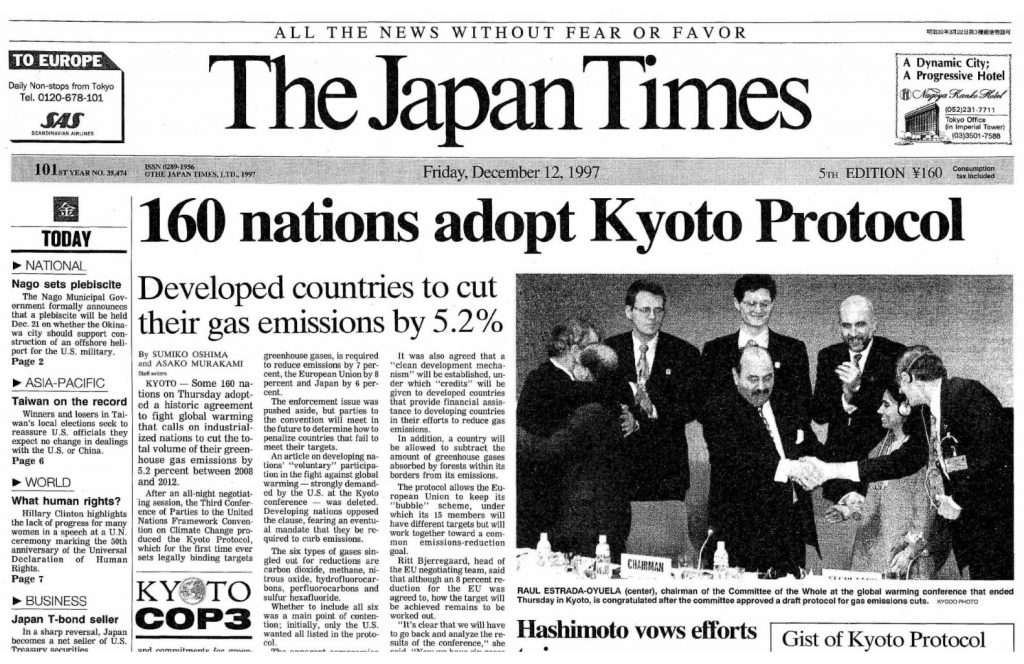

The **Kyoto Protocol** is an international treaty that operationalized the United Nations Framework Convention on Climate Change (UNFCCC) by committing industrialized nations and economies in transition to limit and reduce greenhouse gas (GHG) emissions in accordance with agreed individual targets.
Adopted on **December 11, 1997**, in Kyoto, Japan, and entering into force on **February 16, 2005**, it stands as one of the most critical legal milestones in the history of international climate governance.
### 1. Core Principles and Design
The architecture of the Kyoto Protocol was built on several foundational legal and political concepts:
* **Common But Differentiated Responsibilities (CBDR):** The treaty recognized that developed countries are principally responsible for the historical accumulation of GHG emissions due to decades of industrialization. Therefore, it placed the heavy legal burden of emission reductions strictly on developed nations (listed in **Annex I** of the UNFCCC), while developing countries (Annex II / Non-Annex I, including India and China) were exempt from binding targets during the initial phases.
* **Binding Targets:** Unlike previous aspirational declarations, Kyoto created legally binding emission reduction obligations for industrialized countries.
* **The Six Greenhouse Gases:** The treaty targeted emissions of carbon dioxide (CO_2), methane (CH_4), nitrous oxide (N_2O), hydrofluorocarbons (HFCs), perfluorocarbons (PFCs), and sulphur hexafluoride (SF_6).
### 2. The Flexible Market Mechanisms
To help countries achieve their targets cost-effectively while fostering private sector engagement, Kyoto introduced three groundbreaking **market-based mechanisms**:
1. **International Emissions Trading ("Carbon Market"):** Often referred to as "carbon trading," this allowed countries that had extra emission units (Assigned Amount Units, or AAUs) to sell them to countries that exceeded their targets.
2. **Clean Development Mechanism (CDM):** Allowed developed countries to implement emission-reduction projects in developing countries to earn certified emission reductions (CERs), counting toward their own domestic targets while promoting sustainable development abroad.
3. **Joint Implementation (JI):** Enabled a developed country to earn emission reduction units (ERUs) from an emission-reduction or emission-removal project in another developed country.
### 3. Timeline of Commitment Periods
#### **First Commitment Period (2008–2012)**
* **Target:** Participating industrialized countries committed to reducing their collective greenhouse gas emissions by an average of **5.2% below 1990 levels**.
* **Major Hurdles:**
* The **United States** signed the protocol in 1998 under the Clinton administration, but President George W. Bush formally withdrew the U.S. in 2001, citing exemptions for developing nations like China and potential damage to the American economy.
* Canada later withdrew in 2012 before the first period expired to avoid financial penalties for non-compliance.
* **Outcome:** Despite dropouts, the first period successfully established standard carbon accounting metrics and institutional tracking frameworks, and overall aggregate targets for participating nations were met (largely aided by economic shifts in Eastern Europe post-Soviet collapse).
#### **Second Commitment Period / Doha Amendment (2013–2020)**
* **Adoption:** Adopted on **December 8, 2012**, at the UN Climate Change Conference (COP18) in Doha, Qatar.
* **Target:** Participating countries agreed to reduce GHG emissions by **at least 18% below 1990 levels** across a timeframe running from 2013 to 2020.
* **Hurdles:** By the time the Doha Amendment was negotiated, the geopolitical landscape had dramatically shifted. Major global emitters like the U.S., Canada, Japan, and Russia opted out of taking second-period targets, meaning the amendment only covered a small fraction (roughly 15%) of global emissions. It took years to officially gather enough national ratifications to enter into force.
### 4. Achievements vs. Structural Limitations
| Achievements | Structural Limitations |
|---|---|
| **Pioneered Legal Accountability:** Transformed climate diplomacy from voluntary talks into legally structured international obligations.
**Limited Global Coverage:** Lack of participation by the world's largest historic and modern emitters (such as the U.S. early on, and growing economies like China exempted from strict caps) severely weakened its global impact.
**Normalized Carbon Accounting:** Created global verification standards, registry systems, and monitoring mechanisms for emissions tracking.
**Economic and Structural Leakage:** Industrial activity and emissions sometimes simply shifted to non-participating nations rather than dropping globally.
| **Catalyzed Carbon Markets:** Laid the groundwork for global carbon trading architecture and project-based financing via the CDM. | **Narrow Scope:** Focused strictly on top-down state targets without adequately accommodating fast-changing economic dynamics.
### 5. Transition to the Paris Agreement (Post-2020 Era)
The Kyoto Protocol officially concluded its operational lifecycle when the Doha Amendment lifecycle ended in **2020**.
Long before its conclusion, it became apparent that a rigid, binary division between "developed" and "developing" nations was insufficient to tackle modern global emissions. This realization paved the way for the **2015 Paris Agreement**.
Unlike Kyoto’s top-down, legally mandated targets for rich nations only, the Paris Agreement utilizes a **bottom-up approach** through *Nationally Determined Contributions (NDCs)*, requiring **all** countries—developed and developing alike—to pledge and continuously ramp up climate action.
### Summary Legacy
While the Kyoto Protocol fell short of single-handedly arresting global warming due to political fragmentation and withdrawal by major players, its legacy remains foundational. It built the institutional vocabulary, transparency tools, compliance monitoring, and market mechanisms that continue to influence contemporary international climate law and policy.


0 Thoughts on this article